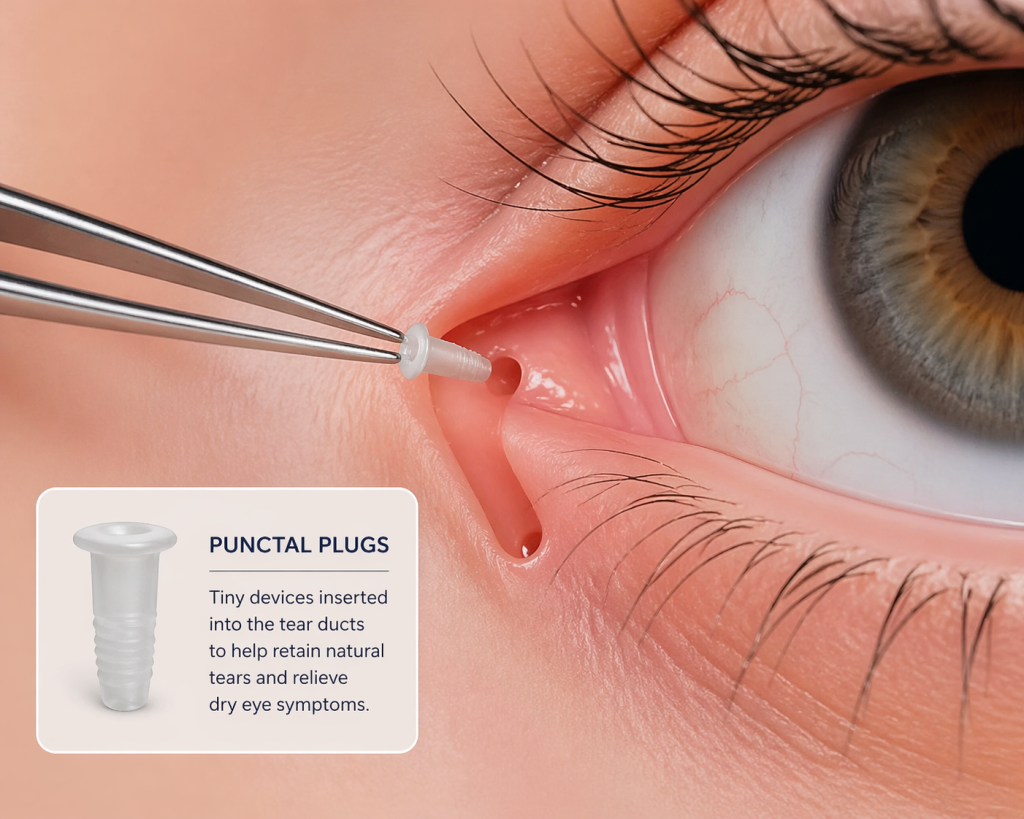
Punctal Plugs for Dry Eye Relief in Saratoga Springs, NY
For patients whose dry eye symptoms are driven by insufficient tear retention, punctal plugs offer a simple, effective, and long-lasting solution. These tiny devices are inserted into the tear drainage openings in the eyelids to reduce tear outflow, keeping your natural tears on the eye’s surface longer. At Saratoga Vision in Saratoga Springs, NY, our experienced optometrists can place punctal plugs quickly and comfortably in-office. Call (518) 587-5900 to schedule your dry eye consultation today.
Book OnlineWhat Are Punctal Plugs?
Punctal plugs — also called lacrimal plugs or occluders — are small, biocompatible devices that are inserted into the puncta: the tiny openings located on the inner corner of the upper and lower eyelids through which tears drain into the nasolacrimal duct and eventually into the back of the throat. By partially or fully blocking these drainage openings, punctal plugs slow the rate at which tears leave the ocular surface, allowing a higher volume of natural (and artificial) tears to remain in contact with the eye for longer.
Punctal plugs are most effective for patients with dry eye caused by aqueous tear deficiency — meaning the lacrimal glands are not producing enough tears. They are also commonly used to enhance the efficacy of prescription eye drops, since reducing drainage keeps the medication on the eye longer. They are one of several tools available through our comprehensive Dry Eye Center.
Types of Punctal Plugs
Punctal plugs come in two main varieties, each with distinct characteristics:
Temporary (Dissolvable) Punctal Plugs
Made from collagen or other absorbable materials, temporary plugs dissolve naturally within a few days to several months depending on the material used. They are often placed first to test whether punctal occlusion is a good fit for a patient without committing to a permanent device. They are also useful for short-term relief — for example, after LASIK surgery when dry eye symptoms are common during healing.
Semi-Permanent (Non-Dissolvable) Punctal Plugs
Made from silicone, acrylic, or hydrogel, these plugs provide longer-lasting occlusion and are the most commonly used type for ongoing dry eye management. They sit in either the vertical canaliculus (intracanalicular plugs) or in the punctal opening (punctal plugs) and can remain in place for years. They can be removed by your optometrist if needed.
The Punctal Plug Placement Procedure
Placement of punctal plugs at Saratoga Vision is a quick, virtually painless in-office procedure. Anesthetic eye drops are applied before the procedure to maximize comfort. Using a specialized instrument, your optometrist will gently insert the plug(s) into one or both puncta — typically in the lower eyelids first, then upper if needed. The entire process takes only a few minutes per eye. Most patients do not feel the plugs after placement and can resume normal activities immediately.
Benefits of Punctal Plugs for Dry Eye
- Provides sustained moisture retention throughout the day without the need for frequent eye drop application
- Enhances the effectiveness of prescription and artificial tear eye drops
- Can be used in combination with other dry eye therapies including OptiLight IPL and Systane® iLux2®
- Reversible — plugs can be removed if they cause any discomfort or if your condition changes
- Low risk and well tolerated by the vast majority of patients
- Can reduce contact lens discomfort in dry eye patients
Not everyone with dry eye is an ideal candidate for punctal plugs. If your dry eye is primarily caused by meibomian gland dysfunction rather than tear deficiency, other treatments may be more effective as the primary intervention. Our optometrists at Saratoga Vision will conduct a thorough dry eye evaluation to determine the right role for punctal plugs in your individualized treatment plan. Call (518) 587-5900 to schedule your consultation.
Frequently Asked Questions About Punctal Plugs
What are punctal plugs and how do they work?
Punctal plugs are tiny biocompatible devices inserted into the tear drainage openings (puncta) of the eyelids to slow the drainage of tears from the eye’s surface. By reducing tear outflow, they help maintain a higher volume of natural and artificial tears on the eye, providing improved lubrication and relief from dry eye symptoms. They are most effective for patients with aqueous tear deficiency and are commonly used as part of a comprehensive dry eye management plan at Saratoga Vision.
Does punctal plug insertion hurt?
No. The punctal plug placement procedure at Saratoga Vision is virtually painless. Anesthetic eye drops are applied beforehand, and most patients feel only very mild pressure or a brief sensation of touch during insertion. The procedure takes only a few minutes and requires no recovery time — you can drive yourself home and resume normal activities immediately. Most patients cannot feel the plugs once they are in place.
How long do punctal plugs last?
The longevity of punctal plugs depends on the type. Temporary collagen plugs dissolve naturally within a few days to a few months. Semi-permanent silicone plugs can last for years with proper placement. Occasionally, silicone plugs may fall out on their own — particularly if they are placed too superficially or if the patient rubs their eyes frequently. If a plug comes out, it can easily be replaced at Saratoga Vision. Call (518) 587-5900 if you think a plug has been lost.
Can punctal plugs be removed?
Yes. Semi-permanent punctal plugs can be removed by your optometrist at any time if they cause irritation, epiphora (excessive tearing), or other issues, or simply if your dry eye condition improves and they are no longer needed. Removal is also a quick and painless in-office procedure. Temporary dissolvable plugs do not need to be removed — they will absorb on their own over time. This reversibility makes punctal plugs a very low-risk intervention for appropriate dry eye patients.
Are punctal plugs right for all dry eye patients?
Punctal plugs are most beneficial for patients with aqueous-deficient dry eye — where the lacrimal glands do not produce enough tear volume. They are less effective as a primary treatment when the main issue is poor tear quality from meibomian gland dysfunction. In those cases, in-office treatments like OptiLight or Systane® iLux2® are better primary interventions. However, plugs can still play a supportive role even in MGD-predominant cases. Our team at Saratoga Vision will evaluate which options are best for your individual dry eye profile.
Will punctal plugs affect my vision?
No. Punctal plugs are placed in the tear drainage openings at the corner of the eyelids, not on the surface of the eye itself. They do not affect vision directly. In fact, many patients notice an improvement in visual clarity because a better-lubricated tear film reduces the blurry vision and visual fluctuation commonly associated with dry eye disease. If you experience any unusual visual symptoms after plug placement, contact Saratoga Vision at (518) 587-5900 right away.
What are the risks of punctal plugs?
Punctal plugs are generally very safe and well tolerated. The most common issue is spontaneous expulsion — particularly with smaller plugs — which can simply be replaced. A small number of patients experience epiphora (excessive watering of the eye) if the plugs over-retain tears, in which case they can be removed or switched to a smaller size. Rarely, plugs can migrate deeper into the canaliculus, requiring removal by a specialist. Our team at Saratoga Vision will monitor your progress after insertion to ensure the plugs are functioning as intended.